
Decluttering advice was designed for the wrong brain
A four-step protocol that turns 200 micro-decisions into four categorical ones.

Hey there!
Mindful, item-by-item decluttering is the wrong format for an ADHD brain.
I know because I’ve been that person standing in a junk drawer, completely frozen, holding something I couldn’t decide what to do with. It took me a while to understand that wasn’t a character flaw. It was a format problem.
KonMari asks you to hold each object and decide whether it sparks joy: keep, donate, or discard, one item at a time, for everything you own. For a neurotypical adult, this can work. The decisions are small, the task is finite, and the repetition provides its own low-grade engagement. For an ADHD brain, the same format creates a completely different experience. Item-by-item evaluation requires sustained, repetitive, low-novelty judgment with no urgency, interest, or stimulation attached to any individual decision. Research on sustained attention in ADHD is consistent here: adults with ADHD show steeper performance decline over the course of a low-stimulation, repetitive task compared to neurotypical adults. Their attention doesn’t just start lower. It falls faster. The longer you stay in item-by-item evaluation mode, the more that gap widens.
That’s not a willpower problem. It’s a task-design problem.
Today’s newsletter explains the mechanism and gives you a different approach — the Batch Sort Protocol — that restructures the task so your brain only has to make a handful of real decisions instead of two hundred small ones.
Let’s walk through it.
Item-by-item decluttering maximizes a specific attentional demand ADHD brains struggle with.
Pick up one thing. Decide. Pick up the next. Decide again. Repeat until the drawer is empty.
This is what the standard decluttering process asks of you. The particular demand it makes — sustained judgment applied repeatedly to low-novelty, low-stimulation objects — is exactly the type of task ADHD brains do worst on. Each individual decision is trivially easy. But making the same type of micro-judgment over and over, with no variation, no urgency, and no reward signal attached to any individual one, creates the conditions under which ADHD attention fails most reliably.
Worth naming what this is not: the ego-depletion model behind “decision fatigue” has well-documented replication problems, and I’m not relying on it here. What the evidence does support is a time-on-task deterioration pattern — adults with ADHD show steeper attentional decline the longer they stay in a sustained, low-stimulation task. The robust finding is the slope, not the starting point. Performance degrades faster. Item-by-item decluttering doesn’t just start hard. It gets harder the longer you’re in it.
Real-world clutter is also messier than the lab tasks this research uses, which typically involve uniform, repetitive stimuli. Your junk drawer has cables, a birthday card from 2019, a broken watch, and a mystery key. That heterogeneity means the evaluative demand isn’t just repetitive — it also requires constant mental reorientation between different types of objects and different evaluation criteria. Sentimental value. Utility. Replacement cost. What-if thinking. That’s an extra layer on top of the sustained attention problem, not instead of it.
The freeze you feel holding a mystery USB adapter isn’t indecision. It’s what happens when a task format collides with a neurological reality.
The Batch Sort Protocol separates the act of sorting from the act of deciding.
The core mechanic: instead of making one decision per object, you make one decision per category. That collapses hundreds of micro-judgments into a handful of categorical ones. Your brain only has to do the hard attention work a few times, not two hundred.
The mechanic works because evaluative judgment is the attentional bottleneck, not physical effort. Moving objects from one place to another is still work — it draws on working memory and physical coordination. But the attentional drag of repeated evaluation is what creates the performance slope. By batching all evaluation into a few categorical decisions, you front-load the hard cognitive work into a handful of concentrated moments, then shift into execution mode, where the task stays physically demanding but cognitively lighter.
This protocol hasn’t been studied as a standalone intervention. It’s a structural extrapolation from what we know about sustained attention in ADHD, not a published clinical recommendation. I’ve walked patients through versions of it with good results, but I want to be straight about what this is and what it isn’t.
It’s also the same instinct as the Friction Protocol from Issue 3, applied to decisions instead of physical steps. That piece was about reducing the number of actions between you and a behavior you’d already decided to take. This one reduces the number of decisions inside a task you’re already doing.
The protocol runs in four steps.
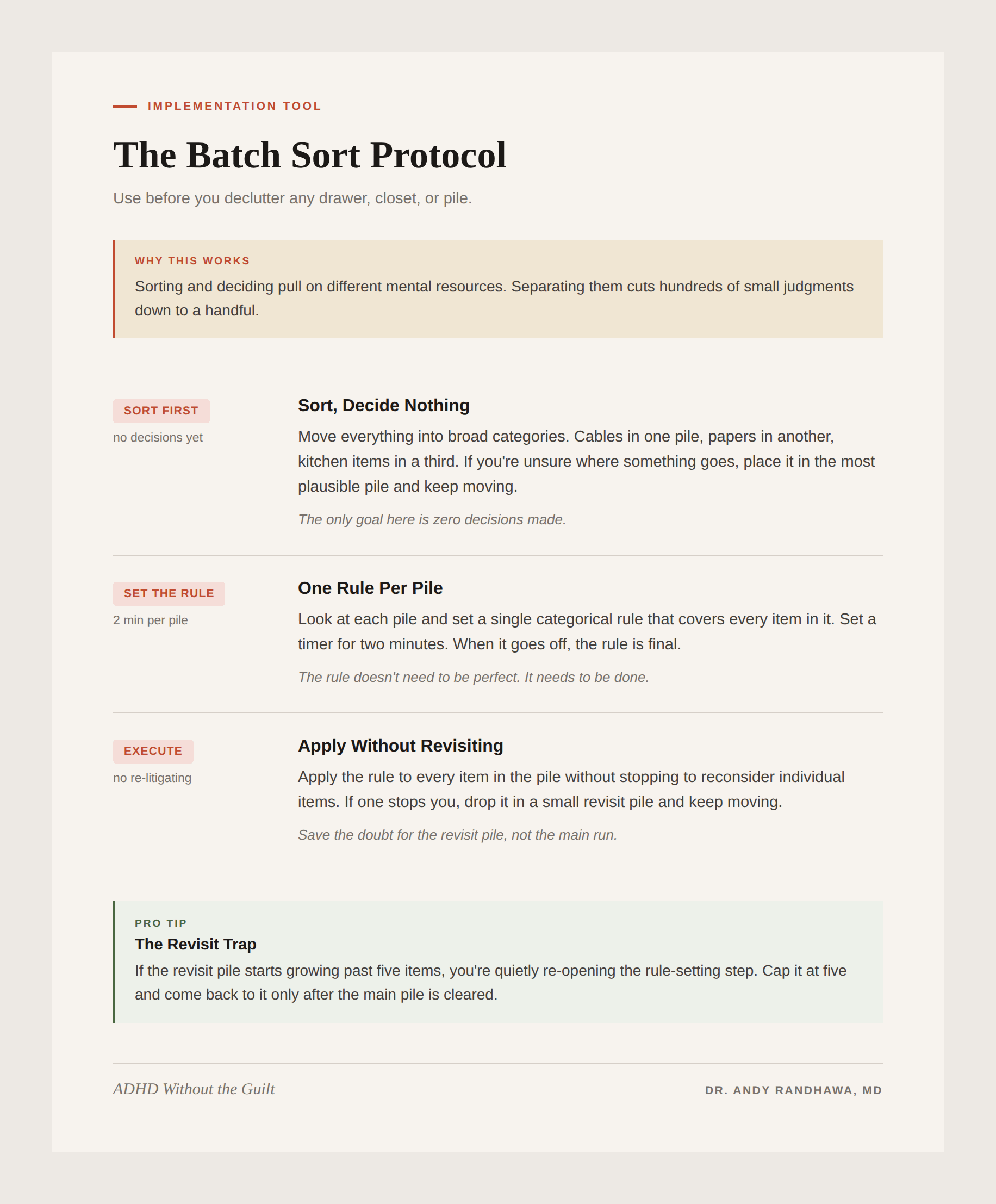
Step 1: Sort first. Decide nothing yet.
Before anything goes into a bin or a donation bag, move everything into broad categories.
Cables go in one pile. Papers in another. Kitchen things in a third. You’re sorting at this stage, not deciding. Sorting feels different from deciding — it’s more kinetic, more automatic. That difference is the point. Sorting into categories still draws on working memory and set-shifting — domains where ADHD creates real friction. But evaluative judgment adds another layer on top: sentimental value, utility, what-if thinking, replacement cost. The hypothesis is that separating the two reduces the combined load. The only goal of this step is to finish it with several piles and zero decisions made. If you catch yourself holding something and wondering whether to keep it, put it in the most plausible pile and keep moving. That question belongs in the next step, not this one.
Step 2: Set one rule per pile, not one decision per item.
Look at each pile and make a single categorical rule.
“All cables go except the three I can identify by sight.” “All papers get recycled except anything with a signature on it.” “Everything in the junk drawer leaves except the scissors and the spare key.” One rule, applied to the entire pile uniformly. You’re no longer deciding about the HDMI cable versus the mystery adapter. You decided about all cables at once.
This is the step that does most of the heavy lifting. A pile of forty items just became one decision.
Step 3: Execute the rule without re-litigating it.
Apply the rule. Don’t revisit it.
This step requires some resistance to the part of your brain that will surface doubts mid-execution. What if I need this someday? What if I regret it? The rule was already set. The time for second-guessing was the thirty seconds you spent in Step 2. That doubt voice isn’t surfacing new information. It’s your brain’s preference for staying in evaluation mode rather than committing to a direction — the same time-on-task drift that makes the standard format fail. Recognizing it for what it is makes it easier to set aside. If an item stops you anyway, put it in a small “revisit” pile rather than letting it interrupt the run. Come back to the revisit pile after the main pile is cleared — at that point it’s almost always easier to work through.
Step 4: Time-box the rule-setting step to two minutes.
Set a timer. When it goes off, the rule is final.
Rule-setting is the one part of this process that still requires real judgment, and it’s also where attention is most likely to spiral if you leave it open-ended. Two minutes per pile. The uncertainty you’re feeling when the timer goes off is usually not a signal that you need more information. It’s a signal that your brain would prefer to stay in the thinking phase rather than execute. Two minutes is enough. The rule is good enough. Move on.
The task design was the problem. It always was.
You didn’t fail at decluttering because you’re disorganized. You failed because item-by-item evaluation is structured in exactly the way your brain does worst: sustained judgment across a long sequence of decisions with no urgency or interest to carry you through any single one — and a performance curve that gets steeper the longer you stay in it.
The Batch Sort Protocol restructures the task so effort is concentrated in a few moments of real decision-making, not spread thin across hundreds of micro-decisions that drain your attention before you’ve finished the first drawer.
Try it on one drawer. See what happens when the task is designed for your brain instead of against it.
Chat soon,
Andy
Want to automate this protocol?
I’ve laid out the strategy above, but I know the hardest part of ADHD management isn’t knowing what to do—it’s the friction of starting.
If you want to bypass that, I’ve built a Clinical Decision Engine for this protocol. You can access that, along with the full protocol PDF, inside the ADHD Command Center.
New to AI? Don’t worry. It’s as simple as copy, paste, and type. I’ve included a 5-minute “Quick-Start Guide” inside the Command Center that will have you up and running in seconds.
I made a Project in Claude to help me with this. I'd identified a pattern of not starting (wasn't hard to locate or name), and offloaded it. Claude knows my landscape and goal now, and gives me assignments, which I can do or not do, no penalty. The first was to inventory everything on my dresser, no touching, no deciding. Then the next day, I was asked to identify the items I'd actually used recently, which was about five things. The rest can go in a bag for later processing (they're still on my dresser, though). Current task is to inventory the things in my three mystery memorabilia boxes. I'm seeing everything differently; it's no longer an undifferentiated mass of avoidance.